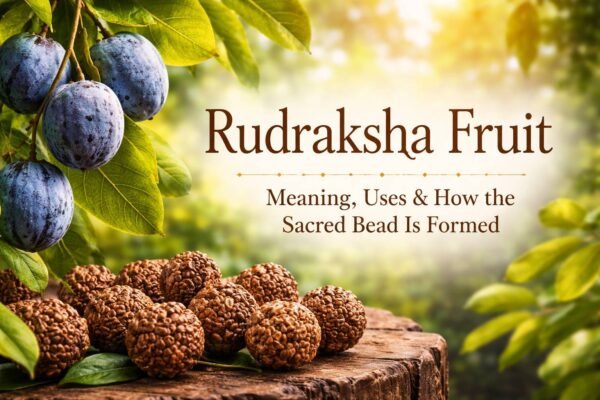
Rudraksha is widely known as a sacred bead used in spiritual practices, meditation, and traditional jewelry. However, before it becomes a bead, it begins its journey as a Rudraksha fruit. Understanding the fruit is essential for anyone interested in the authenticity, quality, and origin of Rudraksha beads.
This comprehensive guide explains what Rudraksha fruit is, how it develops, its physical characteristics, and how the inner seed transforms into the revered Rudraksha bead.
What Is Rudraksha Fruit?
Rudraksha fruit grows on the Rudraksha tree, botanically associated with the species Elaeocarpus ganitrus. The fruit is classified as a drupe, meaning it has a fleshy outer layer surrounding a hard inner stone. This inner stone is what later becomes the Rudraksha bead.
Unlike common fruits grown for consumption, the Rudraksha fruit’s primary value lies not in its pulp but in the seed it protects. The outer fruit layer naturally decomposes or is removed during processing, revealing the hard seed inside.
Appearance of Rudraksha Fruit
Rudraksha fruit is small, rounded, and smooth when young. As it matures, the fruit develops a distinctive appearance:
-
Initially green in color
-
Turns blue or bluish-purple when fully ripe
-
Contains a single hard seed at its center
The blue coloration of the ripe fruit is one of its most striking features and is often cited as a key visual indicator of maturity. Inside the fruit, the hard seed forms with natural grooves that later appear as mukhi lines on the bead.
Why Is Rudraksha Fruit Important?
Rudraksha fruit plays a crucial role in determining the quality of the bead. Factors such as the maturity of the fruit, harvesting method, and drying process directly influence the bead’s structure, durability, and clarity of mukhi lines.
Properly matured fruit produces stronger and more naturally formed beads, while immature or poorly processed fruit can result in cracked or misshapen seeds.
From Fruit to Bead: The Natural Transformation
Many people are unaware that Rudraksha beads are not manufactured or carved. They are naturally formed inside the fruit. The transformation process includes several important stages:
1. Fruit Maturation
The fruit must reach full maturity before harvesting. This ensures the inner seed is completely formed.
2. Harvesting
Harvesting is typically done when the fruit naturally ripens and detaches or is gently picked from the tree. Care is taken to avoid damaging the seed.
3. Soaking
The harvested fruit is soaked in water for several days. This softens the outer pulp, making it easier to remove without harming the seed.
4. Pulp Removal
Once softened, the fleshy outer layer is cleaned off manually. The hard seed inside is revealed.
5. Cleaning and Drying
The seeds are thoroughly washed and then sun-dried. Proper drying prevents moisture retention, mold growth, and cracking.
6. Sorting and Grading
After drying, beads are sorted based on size, shape, and the number of natural grooves or mukhi lines.
Understanding Mukhi Lines in Rudraksha Beads
The mukhi lines seen on Rudraksha beads originate from the internal structure of the seed formed within the fruit. These natural divisions run from one end of the bead to the other and are used to classify Rudraksha beads into different mukhi types.
The clarity and continuity of these lines depend heavily on how well the fruit matured and how gently the seed was processed.
Is Rudraksha Fruit Edible?
Rudraksha fruit is not commonly consumed as food. While it contains a fleshy outer layer, the fruit is primarily valued for its seed rather than its pulp. Traditional and modern usage focuses almost entirely on the inner bead, not on dietary consumption.
Traditional Significance of Rudraksha Fruit
In spiritual traditions, Rudraksha is associated with meditation, mindfulness, and devotion. The fruit is viewed as the origin of a sacred object, making it symbolically important even though it is not used directly.
In traditional systems, different parts of the Rudraksha tree—including leaves, bark, and fruit—are mentioned in historical texts, usually in symbolic or cultural contexts rather than everyday practical use.
Common Misconceptions About Rudraksha Fruit
“Rudraksha is a berry”
While the fruit may resemble a berry in size, it is botanically classified as a drupe due to its hard inner stone.
“Rudraksha beads are carved”
Authentic beads are naturally formed. Artificial carving is considered a sign of imitation.
“All fruits produce high-quality beads”
Quality depends on maturity, climate, and post-harvest handling. Not all fruits yield usable beads.
How to Identify a Quality Rudraksha Bead
Understanding the fruit helps buyers identify authentic beads. Key indicators include:
-
Naturally formed, continuous mukhi lines
-
Firm structure with no hollow sound
-
Slightly rough, organic surface texture
-
Absence of artificial polish or chemical coating
Beads that originate from properly matured fruit tend to last longer and maintain their natural shape over time.
Storage and Care After Processing
Even after the fruit has been removed and the bead is formed, proper care is important:
-
Store beads in a dry, clean environment
-
Avoid prolonged exposure to chemicals
-
Wash gently with clean water if needed
-
Allow to dry fully before storage or use
Good care helps preserve the bead’s structure and appearance for years.
Rudraksha Fruit vs. Rudraksha Bead: Key Differences
| Aspect | Rudraksha Fruit | Rudraksha Bead |
|---|---|---|
| Outer layer | Fleshy pulp | Hard seed |
| Usage | Not commonly used | Meditation, malas |
| Color | Green to blue | Brown to dark brown |
| Role | Protective covering | Sacred object |
Frequently Asked Questions
What is Rudraksha fruit?
Rudraksha fruit is the outer drupe that grows on the Rudraksha tree and contains the seed used to make Rudraksha beads.
Why does Rudraksha fruit turn blue?
The blue color indicates ripeness and maturity of the fruit.
How long does it take to process Rudraksha fruit?
From harvesting to drying, the process can take several weeks depending on climate and drying conditions.
Is every Rudraksha fruit usable?
No. Only fruits with well-formed, undamaged seeds produce usable beads.
Are mukhi lines created after harvesting?
No. Mukhi lines form naturally within the seed while the fruit is still growing on the tree.
Conclusion
Rudraksha fruit is the beginning of the sacred Rudraksha bead’s journey. While the fruit itself is not widely used, its role is essential in shaping the quality, authenticity, and spiritual value of the bead inside. By understanding the fruit’s structure, lifecycle, and processing, buyers and practitioners can make informed decisions and better appreciate the natural origins of Rudraksha.