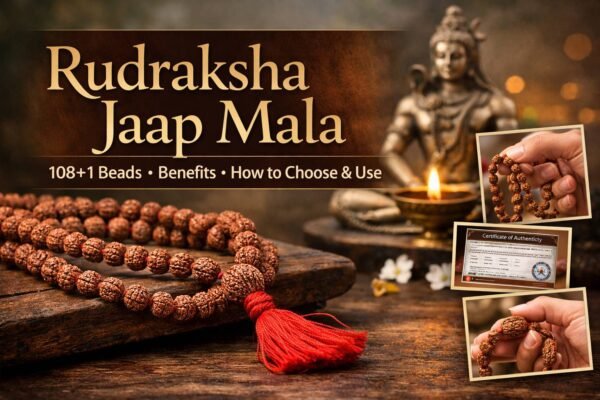
If you’re searching for a Rudraksha Jaap Mala, you’re likely looking for more than just a string of beads. A japa mala is a daily companion for mantra chanting (jaap), meditation, and building steadiness in sadhana. The right mala helps you stay focused, track repetitions without distraction, and create a calm rhythm that supports your practice—whether you chant “Om Namah Shivaya,” Mahamrityunjaya mantra, or your personal guru mantra.
In this guide, you’ll learn what makes a mala truly good for jaap, why most malas are 108+1 beads, how to choose an original Rudraksha mala confidently, and how to use and care for it so it lasts for years.
What is a Rudraksha Jaap Mala?
A Rudraksha japa/jaap mala is a rosary made from Rudraksha beads (seeds traditionally associated with Lord Shiva). It is used to count mantra repetitions while keeping your mind anchored. Instead of checking a clock or counting on fingers, you move one bead at a time, letting the chant and breath become smooth.
A mala typically includes:
-
108 beads for counting
-
1 guru bead (Meru bead) that marks the completion of a round
-
Optional spacers or tassel depending on style and tradition
Why 108+1 beads is considered ideal
The number 108 is widely used in spiritual traditions for japa because it creates a complete “cycle” of chanting. The +1 guru bead is not counted—think of it as a pause point. When you reach it, you complete a round, take a breath, and either stop or reverse direction.
Practical reason: 108 repetitions are long enough to deepen focus but short enough to do daily (even in a busy routine).
Benefits of chanting with a Rudraksha Japa Mala
People choose a Rudraksha jaap mala for different reasons—devotion, discipline, meditation, or simply to reduce distractions. Common benefits devotees report include:
1) Better focus during mantra chanting
The tactile movement of beads keeps your attention from wandering. Your hands stay busy so your mind becomes quieter.
2) Consistency in daily sadhana
A mala gives structure. One full round (108) becomes a simple daily goal you can keep.
3) Calmer, steadier meditation
When chanting becomes rhythmic, breathing often settles naturally. Many practitioners find this supports meditation after japa as well.
4) A “personal” spiritual tool
Over time, your mala becomes familiar—like a bookmark in your practice. The feeling of the beads itself can cue the mind to enter a prayerful state.
Note: Spiritual experiences vary from person to person. A mala is a tool—your consistency and intention matter most.
Which Rudraksha mala is best for jaap?
For most people, a Panchmukhi (5 Mukhi) Rudraksha Jaap Mala is the most popular starting point. It’s widely used for everyday chanting and is suitable for a broad range of practitioners.
However, the “best” mala depends on your comfort, bead size preference, and how you plan to use it:
-
Daily japa at home: medium bead size (comfortable grip)
-
Meditation + wear as necklace: smoother finish, durable knotting
-
Travel chanting: slightly smaller beads for portability
If your store has multiple options (5 Mukhi, combinations, premium lines), consider presenting them as: Beginner / Daily Sadhana / Premium / Large Beads so buyers can pick quickly.
How to choose an original Rudraksha Jaap Mala (buyer checklist)
When shoppers search “original rudraksha mala for jaap,” they usually worry about authenticity and quality. Here’s what to check:
1) Bead quality (surface + mukhi lines)
-
Natural mukhi lines should look organic, not carved or painted.
-
Avoid beads that look overly “perfect” or artificially uniform.
2) Knotting and thread durability
A jaap mala is handled daily. Strong knotting between beads helps prevent damage and makes the mala last longer. Look for clean spacing and sturdy thread.
3) Bead size (comfort matters)
Common sizes range from small to large. Bigger beads are easier to grip; smaller beads are lighter and easier to carry. Choose what feels natural in your hand—because you’ll be touching it hundreds of times.
4) Guru bead + tassel finishing
A well-made guru bead connection and neat tassel/ending shows attention to craftsmanship.
5) Trust signals from the seller
On a product page, clearly show:
-
authenticity/certification approach (lab testing if offered)
-
sourcing location (if applicable)
-
return/replacement policy
-
clear photos and close-ups
How to use a Rudraksha Jaap Mala (step-by-step)
If you’re new, keep it simple:
-
Sit comfortably (cross-legged or on a chair) with a straight spine.
-
Hold the mala in your right hand (common practice; follow your tradition if different).
-
Start from the bead next to the guru bead.
-
Chant one mantra per bead, moving one bead at a time.
-
When you reach the guru bead, you’ve completed 108.
-
If you want another round, reverse direction instead of crossing over the guru bead.
Tip for beginners: start with 1 round daily. Build consistency first, then increase rounds.
Rudraksha Mala care: keep it clean, energized, and long-lasting
Rudraksha is natural. With simple care, your mala can last many years.
-
Avoid chemicals: keep away from perfume, harsh soaps, and strong detergents.
-
Keep it dry: if it gets wet, dry gently with a soft cloth.
-
Store respectfully: in a clean pouch or sacred space when not in use.
-
Light oiling (optional): some traditions use a tiny amount of natural oil occasionally to prevent dryness—only if advised by your seller/tradition.
Who can wear a Rudraksha Jaap Mala?
Most people can use a Rudraksha japa mala for chanting regardless of age. The key is respect and regularity. If you’re buying it as a gift, choose a classic 108+1 mala with comfortable bead size and strong knotting.
FAQs
1) How many beads are in a Rudraksha Jaap Mala?
Most are 108 beads plus 1 guru bead (108+1).
2) Can I wear my japa mala like a necklace?
Yes—many people do. If you plan to wear it daily, choose durable knotting and a comfortable bead size.
3) Which is better: 5 Mukhi or other mukhis for japa?
For general daily chanting, 5 Mukhi is the most common choice. Other mukhis are often chosen for specific preferences and traditions.
4) How do I know if my Rudraksha mala is original?
Look for natural mukhi lines, real-bead texture, consistent craftsmanship, and buy from a seller who provides clear authenticity assurances and close-up images.
5) Can I chant different mantras on the same mala?
Yes. Many people use one mala for their main practice. If your tradition recommends separate malas for specific mantras, follow that guidance.
6) What is the guru bead used for?
It marks the beginning/end of one round. You don’t count it—when you reach it, you complete 108.
7) Can I use a Rudraksha mala for meditation without chanting?
Yes. Some people move beads with breath counting, or simply hold the mala during meditation.
8) How often should I clean my Rudraksha mala?
Only as needed—keep it dry and clean. Avoid frequent washing with soap. Gentle wiping is usually enough.
Ready to choose your Rudraksha Jaap Mala?
A good Rudraksha Jaap Mala 108+1 should feel comfortable in your hand, be made with solid knotting, and come from a seller who’s transparent about authenticity and quality. Once you pick the right mala, the most important step is simple: use it every day—even if it’s just one round.